
PT
1

Hãy nhập câu hỏi của bạn vào đây, nếu là tài khoản VIP, bạn sẽ được ưu tiên trả lời.
a) sin = đối / huyền => sinx < 1 => sinx - 1 < 0
b) cos = kề / huyền => cosx < 1 => 1 - cosx > 0
c) sinx - cosx = sinx - sin(90-x)
Nếu x > 90-x hay x > 45 thì sinx - sin(90-x) > 0 hay sinx - cosx > 0
Nếu x < 90-x hay x < 45 thì sinx - sin(90-x) < 0 hay sinx - cosx < 0
d) Tương tự câu c)
\(\tan x=\frac{\sin x}{\cos x}=\frac{3}{5}\Rightarrow\sin x=\frac{3}{5}\cos x\)
\(\Rightarrow N=\frac{\sin x.\cos x}{\sin^2x-\cos^2x}=\frac{\sin x.\cos x}{\left(\sin x-\cos x\right)\left(\sin x+\cos x\right)}\)
\(=\frac{\frac{3}{5}.\cos^2x}{\left(\frac{3}{5}\cos x-\cos x\right)\left(\frac{3}{5}\cos x+\cos x\right)}=\frac{\frac{3}{5}\cos^2x}{\frac{-16}{25}.\cos^2x}=\frac{-15}{16}\)
2: \(\left(sinx+cosx\right)^2=1+2\cdot sinx\cdot cosx=1+2\cdot\dfrac{\sqrt{3}}{4}=1+\dfrac{\sqrt{3}}{2}=\dfrac{2+\sqrt{3}}{2}\)
=>\(sinx+cosx=\dfrac{\sqrt{3}+1}{2}\)
mà sin x*cosx=căn 3/4
nên sinx,cosx là các nghiệm của phương trình là:
\(a^2-\dfrac{\sqrt{3}+1}{2}\cdot a+\dfrac{\sqrt{3}}{4}=0\)
=>\(\left[{}\begin{matrix}a=\dfrac{\sqrt{3}}{2}\\a=\dfrac{1}{2}\end{matrix}\right.\)
Ta sẽ có hai trường hợp:
TH1: sin x=căn 3/2; cosx=1/2
tan x=sinx/cosx=căn 3
cot x=1/căn 3
TH2: sin x=1/2; cosx=căn 3/2
tan x=sin x/cosx=1/căn 3
cot x=1:1/căn 3=căn 3
Sửa đề: sin x=3/5
Ta có: \(\sin^2x+cos^2x=1\)
=>\(cos^2x=1-\left(\frac35\right)^2=1-\frac{9}{25}=\frac{16}{25}\)
=>\(cosx=\sqrt{\frac{16}{25}}=\frac45\)
Ta có: \(\tan x=\frac{\sin x}{cosx}\)
\(=\frac35:\frac45=\frac34\)
Ta có: \(\cot x=\frac{1}{\tan x}\)
=>\(\cot x=1:\frac34=\frac43\)
\(cosx=\sqrt{1-\dfrac{7}{16}}=\dfrac{3}{4}\)
\(tanx=\dfrac{\sqrt{7}}{4}:\dfrac{3}{4}=\dfrac{\sqrt{7}}{3}\)
\(cotx=1:\dfrac{\sqrt{7}}{3}=\dfrac{3}{\sqrt{7}}=\dfrac{3\sqrt{7}}{7}\)
\(M=\left(\dfrac{3}{7}\sqrt{7}+\dfrac{1}{3}\sqrt{7}\right):\left(\dfrac{3}{7}\sqrt{7}-\dfrac{1}{3}\sqrt{7}\right)\)
\(=\dfrac{16}{21}:\dfrac{2}{21}=8\)
a) ta có : \(sin^2x+cos^2x=1\Leftrightarrow\dfrac{9}{25}+cos^2x=1\Leftrightarrow cos^2x=\dfrac{16}{25}\)
\(\Rightarrow cosx=\pm\dfrac{4}{5}\)
ta có : \(tanx=\dfrac{sinx}{cosx}=\dfrac{\dfrac{3}{5}}{\pm\dfrac{4}{5}}=\pm\dfrac{3}{4}\) \(\Rightarrow cot=\dfrac{1}{tan}=\dfrac{1}{\pm\dfrac{3}{4}}=\pm\dfrac{4}{3}\)
vậy ................................................................................................
b) ta có : \(tanx=\sqrt{3}\Leftrightarrow cotx=\dfrac{1}{tanx}=\dfrac{1}{\sqrt{3}}\)
ta có : \(\dfrac{sin^2x+cos^2x}{cos^2x}=1+tan^2x\Leftrightarrow\dfrac{1}{cos^2x}=1+tan^2x\)
\(\Leftrightarrow\dfrac{1}{cos^2x}=1+\left(\sqrt{3}\right)^2=4\Rightarrow cos^2x=\dfrac{1}{4}\) \(\Leftrightarrow cos^2x=\pm\dfrac{1}{2}\)
ta có : \(sin^2x+cos^2x=1\Leftrightarrow sin^2x=1-\dfrac{1}{4}=\dfrac{3}{4}\Rightarrow sinx=\pm\dfrac{\sqrt{3}}{2}\)
vậy .............................................................................................
câu c bn làm tương tự câu a ; còn câu d bn làm tương tự câu b nha :)
Ta có: tan(x)=12/53 ==> x= \(tan^{-1}\left(\frac{12}{53}\right)\)=69 độ 56 phút 56.25 giây.
nên sinx=0,9394, cotx=0.3650 ( mình làm tròn đến số thập phân thứ 4 nha bạn)
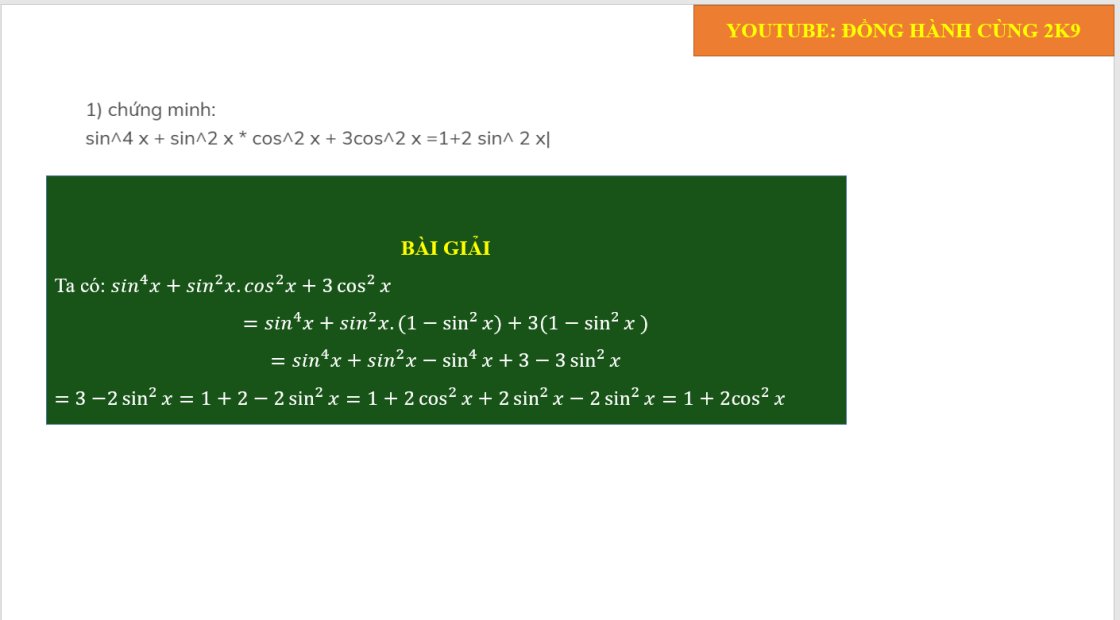
Vì x là góc nhọn nên tan x>0; cot x>0; sin x>0; cosx>0
Ta có: \(\tan x-3\cdot\cot x=2\)
=>\(\tan x-\frac{3}{\tan x}=2\)
=>\(\tan^2x-3=2\cdot\tan x\)
=>\(\tan^2x-2\cdot\tan x-3=0\)
=>\(\left(\tan x-3\right)\left(\tan x+1\right)=0\)
=>tan x=3(nhận) hoặc tan x=-1(loại)
tan x=3
=>cot x=\(\frac{1}{\tan x}=\frac13\)
Ta có: \(1+\tan^2x=\frac{1}{cos^2x}\)
=>\(\frac{1}{cos^2x}=1+3^2=10\)
=>\(cos^2x=\frac{1}{10}\)
=>\(cosx=\frac{1}{\sqrt{10}}\)
Ta có: \(\sin^2x+cos^2x=1\)
=>\(\sin^2x=1-\frac{1}{10}=\frac{9}{10}\)
=>\(sinx=\sqrt{\frac{9}{10}}=\frac{3}{\sqrt{10}}\)