
Hãy nhập câu hỏi của bạn vào đây, nếu là tài khoản VIP, bạn sẽ được ưu tiên trả lời.

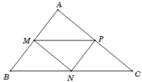
Do M là trung điểm BC nên: \(\overrightarrow{AM}=\dfrac{1}{2}\overrightarrow{AB}+\dfrac{1}{2}\overrightarrow{AC}\)
Tương tự: \(\overrightarrow{BN}=\dfrac{1}{2}\overrightarrow{BA}+\dfrac{1}{2}\overrightarrow{BC}\) ; \(\overrightarrow{CP}=\dfrac{1}{2}\overrightarrow{CA}+\dfrac{1}{2}\overrightarrow{CB}\)
Cộng vế:
\(\overrightarrow{AM}+\overrightarrow{BN}+\overrightarrow{CP}=\dfrac{1}{2}\overrightarrow{AB}+\dfrac{1}{2}\overrightarrow{AC}+\dfrac{1}{2}\overrightarrow{BA}+\dfrac{1}{2}\overrightarrow{BC}+\dfrac{1}{2}\overrightarrow{CA}+\dfrac{1}{2}\overrightarrow{CB}\)
\(=\dfrac{1}{2}\left(\overrightarrow{AB}+\overrightarrow{BA}\right)+\dfrac{1}{2}\left(\overrightarrow{AC}+\overrightarrow{CA}\right)+\dfrac{1}{2}\left(\overrightarrow{BC}+\overrightarrow{CB}\right)=\overrightarrow{0}\)
b. Từ câu a ta có:
\(\overrightarrow{AM}+\overrightarrow{BN}+\overrightarrow{CP}=\overrightarrow{0}\)
\(\Leftrightarrow\overrightarrow{AO}+\overrightarrow{OM}+\overrightarrow{BO}+\overrightarrow{ON}+\overrightarrow{CO}+\overrightarrow{OP}=\overrightarrow{0}\)
\(\Leftrightarrow-\overrightarrow{OA}+\overrightarrow{OM}-\overrightarrow{OB}+\overrightarrow{ON}-\overrightarrow{OC}+\overrightarrow{OP}=\overrightarrow{0}\)
\(\Leftrightarrow\overrightarrow{OA}+\overrightarrow{OB}+\overrightarrow{OC}=\overrightarrow{OM}+\overrightarrow{ON}+\overrightarrow{OP}\) (đpcm)
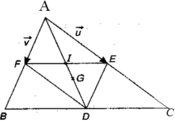

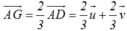
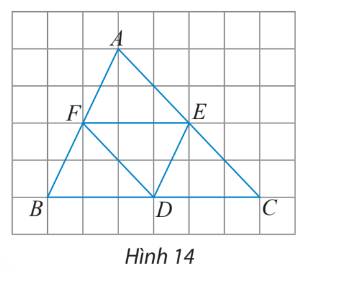
Từ giả thiết ta có:
\(AF = FB = ED\); \(AE = EC = FD\); \(BD = DC = EF\)
Từ đó dựa vào hình ta có:
a) Các vectơ bằng vectơ \(\overrightarrow {EF} \)là \(\overrightarrow {DB} \) và \(\overrightarrow {CD} \)
b) Các vectơ đối vectơ \(\overrightarrow {EC} \) là \(\overrightarrow {EA} \) và \(\overrightarrow {DF} \)
Lời giải:
a)
$2\overrightarrow{AD}=\overrightarrow{AD}+\overrightarrow{AD}$
$=\overrightarrow{AB}+\overrightarrow{BD}+\overrightarrow{AC}+\overrightarrow{CD}$
$=\overrightarrow{AB}+\overrightarrow{AC}+(\overrightarrow{BD}+\overrightarrow{CD})$
$=\overrightarrow{AB}+\overrightarrow{AC}$
$\Rightarrow \overrightarrow{AD}=\frac{\overrightarrow{AB}+\overrightarrow{AC}}{2}$
Tương tự:
$\overrightarrow{BE}=\frac{\overrightarrow{BC}+\overrightarrow{BA}}{2}$
$\overrightarrow{CF}=\frac{\overrightarrow{CA}+\overrightarrow{CB}}{2}$
Cộng lại:
$\overrightarrow{AD}+\overrightarrow{BE}+\overrightarrow{CF}=\frac{\overrightarrow{AB}+\overrightarrow{BA}+\overrightarrow{AC}+\overrightarrow{CA}+\overrightarrow{BC}+\overrightarrow{CB}}{2}=\frac{\overrightarrow{0}+\overrightarrow{0}+\overrightarrow{0}}{2}=\overrightarrow{0$}$
Ta có đpcm.
b)
$\overrightarrow{MA}+\overrightarrow{MB}+\overrightarrow{MC}=\overrightarrow{MD}+\overrightarrow{DA}+\overrightarrow{ME}+\overrightarrow{EB}+\overrightarrow{MF}+\overrightarrow{FC}$
$=(\overrightarrow{MD}+\overrightarrow{ME}+\overrightarrow{MF})+(\overrightarrow{DA}+\overrightarrow{EB}+\overrightarrow{FC})$
$=(\overrightarrow{MD}+\overrightarrow{ME}+\overrightarrow{MF})-(\overrightarrow{AD}+\overrightarrow{BE}+\overrightarrow{CF})$
$=\overrightarrow{MD}+\overrightarrow{ME}+\overrightarrow{MF}-\overrightarrow{0}$ (theo phần a)
$=\overrightarrow{MD}+\overrightarrow{ME}+\overrightarrow{MF}$
Ta có đpcm.
\(\overrightarrow{OA}+\overrightarrow{OB}+\overrightarrow{OC}+\overrightarrow{OD}=2\cdot\left(\overrightarrow{OE}+\overrightarrow{OF}\right)=\overrightarrow{0}\)
 nên
nên 
xét tứ giác AECF: có AE = FC và AE//FC => AECF là hình bình hành => AF//CE
xét △DNC: có F là trung điểm của DC và FM//CN (đường tb) => M là trung điểm của DN => vtDM = vtMN (1)
xét △BMA: có E là trung điểm của AB và NE//AM ( đường tb) => N là trung điểm của MB => BM=MN (2)
từ (1) và (2) suy ra : DM=MN=NB => vtDM = vtMN = vtNB ( cùng hướng, cùng độ lớn)
A B C D E M N F
a: Xét ΔBAC có
E,F lần lượt là trung điểm của BA,BC
=>EF là đường trung bình của ΔBAC
=>EF//AC và \(EF=\frac{AC}{2}\)
=>\(\overrightarrow{EF};\overrightarrow{AC}\) là các vecto cùng phương(1)
Xét ΔDAC có
N,M lần lượt là trung điểm của DA,DC
=>NM là đường trung bình của ΔDAC
=>NM//AC và \(NM=\frac{AC}{2}\)
=>\(\overrightarrow{NM};\overrightarrow{AC}\) là các vecto cùng phương(2)
Từ (1),(2) suy ra \(\overrightarrow{NM};\overrightarrow{EF};\overrightarrow{AC}\) là các vecto cùng phương
b: EF//AC
NM//AC
Do đó: EF//NM
\(EF=\frac{AC}{2}\)
\(NM=\frac{AC}{2}\)
Do đó: EF=NM
Xét tứ giác EFMN có
EF//MN
EF=MN
Do đó: EFMN là hình bình hành