
Hãy nhập câu hỏi của bạn vào đây, nếu là tài khoản VIP, bạn sẽ được ưu tiên trả lời.











Vì \(b\ne d;b+d\ne0\) nên áp dụng tính chất cảu dãy tỉ số bằng nhau ta có:
\(\dfrac{a}{b}=\dfrac{c}{d}=\dfrac{a+c}{b+d}=\dfrac{a-c}{b-d}\)
Vậy \(\dfrac{a+c}{b+d}=\dfrac{a-c}{b-d}\) (đpcm)
Chúc bạn học tốt!!!
Ta có:Nếu
\(\dfrac{a+c}{b+d}=\dfrac{a-c}{b-d}\)
thì \((a+c)(b-d)=(a-c)(b+d)\)
\(a(b-d)+c(b-d)=a(b+d)-c(b+d)\)
\(ab-ad+bc-cd=ab+ad-bc+cd\)
\(=\)\(ab-ab\)\(-ad+ad\)\(+bc-bc\)\(-cd+cd\)
\(=0\)
\(\Leftrightarrow\left(a+c\right)\left(b-d\right)\)\(=\left(a-c\right)\left(b+d\right)\)
\(\Leftrightarrow\dfrac{a+c}{b+d}\)\(=\dfrac{a-c}{b-d}\)
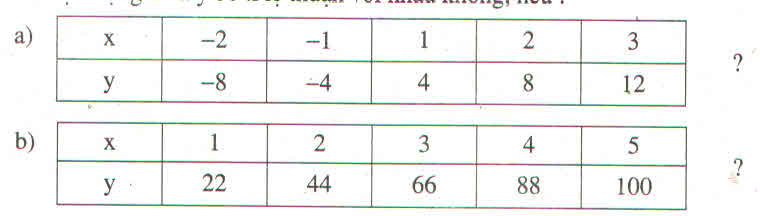
a)\(\dfrac{-8}{-2}=\dfrac{-4}{-1}=\dfrac{4}{1}=\dfrac{8}{2}=\dfrac{12}{3}=4\)
Vậy hai đại lượng x và y ở bảng a) tỉ lệ thuận với nhau.
b) \(\dfrac{22}{1}\ne\dfrac{100}{5}\)
Vậy hai đại lượng x và y ở bảng b không tỉ lệ thuận với nhau.

\(a,x^2-113=31\\ \Leftrightarrow x^2=144\\ \Leftrightarrow x=\pm12\\ Vay...\\ b,\sqrt{x+2,29}=2.3\\ \Leftrightarrow x+2,29=6^2\\ x=36-2,29=33,71\\ c,x^4=256\\ \Leftrightarrow x=\pm4\\ Vay...\\ d,\left(\sqrt{x}-1\right)^2=0,5625\\ \Leftrightarrow\sqrt{x}-1\in\left\{-0,75;0,75\right\}\\ \Leftrightarrow\sqrt{x}\in\left\{0,25;1,75\right\}\\ Vay...\\ e,2\sqrt{x}-x=0\\ \Leftrightarrow\sqrt{x}\left(2-\sqrt{x}\right)=0\\ \Leftrightarrow\sqrt{x}=0hoac2-\sqrt{x}=0\\ \Leftrightarrow x=0hoacx=4\\ f,x+\sqrt{x}=0\\ \Leftrightarrow\sqrt{x}\left(\sqrt{x}+1\right)=0\\ \Leftrightarrow x=0hoacx=1\)
a. x2−113=31
=> x2=144
=> x2=\(\sqrt{144}\)
=> x=\(\pm12\)
c.x4=256
=> x4=44
=> x=\(\pm4\)


>> Mình không chép lại đề bài nhé ! <<
Cách 1 :
\(A=\left(\dfrac{36-4+3}{6}\right)-\left(\dfrac{30+10-9}{6}\right)-\left(\dfrac{18-14+15}{6}\right)=\dfrac{35}{6}-\dfrac{31}{6}-\dfrac{19}{6}=-\dfrac{15}{6}=-\dfrac{5}{2}\)
Cách 2 :
\(A=6-\dfrac{2}{3}+\dfrac{1}{2}-5+\dfrac{5}{3}-\dfrac{3}{2}-3-\dfrac{7}{3}+\dfrac{5}{2}\)
\(A=\left(6-5-3\right)-\left(\dfrac{2}{3}+\dfrac{5}{3}-\dfrac{7}{3}\right)+\left(\dfrac{1}{2}+\dfrac{3}{2}-\dfrac{5}{2}\right)\)
\(A=-2-0-\dfrac{1}{2}=-\dfrac{5}{2}\)
Cách 1 :
\(\left(6-\dfrac{2}{3}+\dfrac{1}{2}\right)-\left(5+\dfrac{5}{3}-\dfrac{3}{2}\right)-\left(3-\dfrac{7}{3}+\dfrac{5}{2}\right)\)
\(=\left(\dfrac{36}{6}-\dfrac{4}{6}+\dfrac{3}{6}\right)-\left(\dfrac{30}{6}+\dfrac{10}{6}-\dfrac{9}{6}\right)-\left(\dfrac{18}{6}-\dfrac{14}{6}+\dfrac{15}{6}\right)\)
\(=\dfrac{35}{6}-\dfrac{31}{6}-\dfrac{19}{6}\)
\(=-\dfrac{5}{2}\)
Cách 2 :
\(\left(6-\dfrac{2}{3}+\dfrac{1}{2}\right)-\left(5+\dfrac{5}{3}-\dfrac{3}{2}\right)-\left(3-\dfrac{7}{3}+\dfrac{5}{2}\right)\)
\(=6-\dfrac{2}{3}+\dfrac{1}{2}-5-\dfrac{5}{3}+\dfrac{3}{2}-3+\dfrac{7}{3}-\dfrac{5}{2}\)
\(=\left(6-5-3\right)+\left(\dfrac{-2}{3}+\dfrac{-5}{3}+\dfrac{7}{3}\right)+\left(\dfrac{1}{2}+\dfrac{3}{2}+\dfrac{-5}{2}\right)\)
\(=\left(-2\right)+0+\dfrac{-1}{2}\)
\(=\dfrac{-5}{2}\)
A B C H I K M
a) Xét hai tam giác ABI và AKI có:
AB = AK (gt)
\(\widehat{BAI}=\widehat{KAI}\left(gt\right)\)
AI: cạnh chung
Vậy \(\Delta ABI=\Delta AKI\left(c-g-c\right)\)
b) Vì AB = AK (gt)
\(\Rightarrow\Delta ABK\) cân tại A
\(\Rightarrow\) AI là đường phân giác đồng thời là đường trung trực của BK
Vậy AI \(\perp\) BK
c) Ta có: \(\widehat{ABI}+\widehat{IBH}=180^o\) (kề bù)
\(\widehat{AKI}+\widehat{IKC}=180^o\) (kề bù)
Mà \(\widehat{ABI}=\widehat{AKI}\left(\Delta ABI=\Delta AKI\right)\)
\(\Rightarrow\widehat{IBH}=\widehat{IKC}\)
Xét hai tam giác IBH và IKC có:
\(\widehat{IBH}=\widehat{IKC}\left(cmt\right)\)
IB = IC (\(\Delta ABI=\Delta AKI\))
\(\widehat{BIH}=\widehat{KIC}\) (đối đỉnh)
Vậy \(\Delta IBH=\Delta IKC\left(g-c-g\right)\)
Suy ra: IH = IC (hai cạnh tương ứng)
Do đó: \(\Delta IHC\) cân tại I
d) Ta có: AH = AB + BH
AC = AK + KC
Mà AB = AK (gt)
BH = KC (\(\Delta IBH=\Delta IKC\))
\(\Rightarrow\) AH = AC
\(\Rightarrow\) \(\Delta AHC\) cân tại A
e) \(\Delta AHC\) cân tại A có AI là đường phân giác đồng thời là đường cao
hay AI \(\perp\) HC
Mà AI \(\perp\) BK (cmt)
Do đó: BK // HC
i) Xét hai tam giác AHM và ACM có:
AH = AC (cmt)
MH = MC (gt)
AM: cạnh chung
Vậy \(\Delta AHM=\Delta ACM\left(c-c-c\right)\)
\(\Rightarrow\widehat{HAM}=\widehat{CAM}\) (hai góc tương ứng)
\(\Rightarrow\) AM là tia phân giác của \(\widehat{HAC}\)
Mà AI là tia phân giác của \(\widehat{BAK}\)
Vậy AI trùng AM hay ba điểm A, I, M thẳng hàng (đpcm).
lỗi part 2
y=-10
lỗi ạ
Ta có : x và y là hai đại lượng tỉ lệ thuận
\(\Rightarrow y=kx\Leftrightarrow k=\dfrac{-4}{2}=-2\)
Theo đó, khi x = 5 thì :
\(\Rightarrow y=k.x=-2.5=-10\)
đề lỗi bn ơi