
HD
1

Hãy nhập câu hỏi của bạn vào đây, nếu là tài khoản VIP, bạn sẽ được ưu tiên trả lời.
Title: Proposal for a welcome Event for New Students
To: The School Board and Teachers
Date: September 20,2025
Prepared by: Class 11B
Introduction:
This proposal aims to organize a welcome event to greet new members joining our school community
Details about the idea/project:
The event will take place in the school playgroupd on October 5,2025. It will include ice-breaking games, group activities, and short performances by students
Goals and benefits:
The event helps new members feel more comfortable, encourages teamwork, and creates a friendly school environment
Conclusion:
We kindly ask the school leaders to consider and approve this proposal so the event can be successfully organized
Viết một bài văn về nguyên nhân và ảnh hưởng của sự nóng lên toàn cầu và các giải pháp khả thi.
Phần mở đầu: (Giới thiệu chủ đề & nội dung chính của bài văn)
- một trong những vấn đề lớn nhất mà con người phải đối mặt ngày nay
- chủ yếu do con người gây ra
- tác động thảm khốc nhất đối với con người
- con người phải thực hiện các hành động để giảm thiểu rủi ro
- bài luận sẽ thảo luận về nguyên nhân và ảnh hưởng, và các giải pháp khả thi
Phần thân
1. Nguyên nhân của sự nóng lên toàn cầu
- Khí thải carbon dioxide từ việc đốt nhiên liệu hóa thạch trong các kế hoạch điện và xe có động cơ
- phá rừng để lấy đất trồng trọt, gỗ và giấy
- tăng cường sử dụng phân bón hóa học trên đất trồng trọt
2. Ảnh hưởng của sự nóng lên toàn cầu
- bệnh tật liên quan đến nhiệt và tử vong, và lây lan các bệnh truyền nhiễm
- Sự tan chảy của các chỏm băng ở hai cực và sự dâng cao của mực nước biển → Người dân mất nhà cửa
- các kiểu thời tiết khắc nghiệt như bão nghiêm trọng, sóng nhiệt, lũ lụt và hạn hán → Thiếu nước và lương thực
- sự tuyệt chủng trên diện rộng của các loài
3. Một số giải pháp khả thi
- giảm sử dụng năng lượng
- trồng cây hoặc thực vật
- sử dụng các phương tiện giao thông xanh
Sự kết luận
- Tóm tắt những điểm chính
- Phát biểu ý kiến của bạn
Gợi ý trả lời
Xem thêm về văn bản nguồn nàyNhập văn bản nguồn để có thông tin dịch thuật bổ sung
Gửi phản hồi
Bảng điều khiển bên
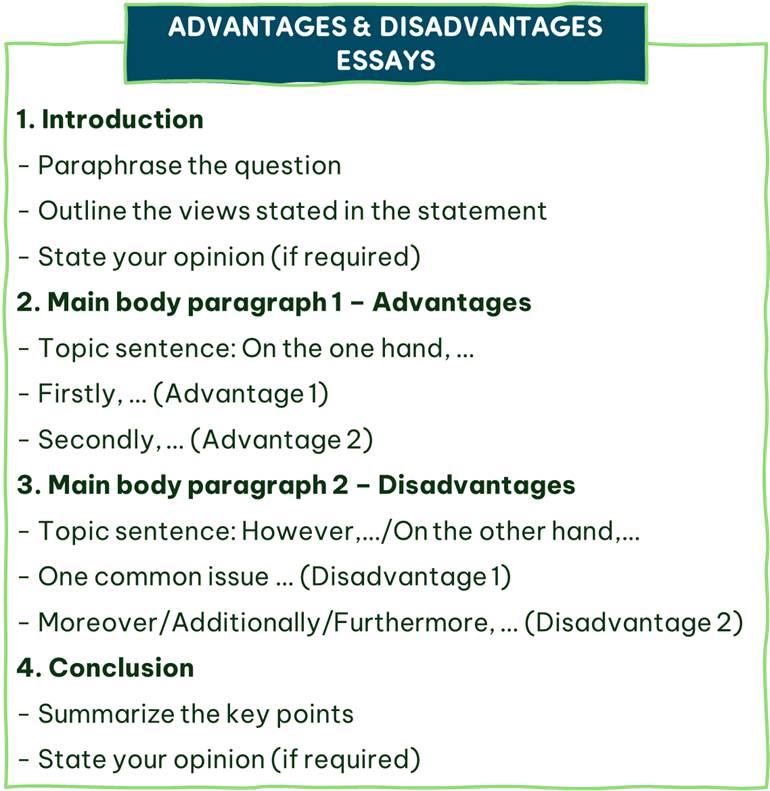
Living in a smart city brings many benefits and disadvantages. In this article, I will present some pros and cons of living in a smart city.
The first advantage of living in a smart city is convenience. Information and communications technology is integrated into urban systems, helping to provide public services more effectively. For example, through mobile applications, people can easily search for information about transportation, destinations, and entertainment activities. Furthermore, the smart traffic system helps reduce congestion and save travel time.
Another advantage of smart cities is energy saving and environmental protection. Advanced technologies are applied to manage and use resources effectively. For example, automatic lighting and temperature regulation in buildings help save energy. In addition, the use of smart public transport and self-driving cars helps reduce polluting emissions.
However, living in a smart city also has disadvantages. One of them is the issue of information security. With the widespread use of information technology, the risk of personal information insecurity and privacy violations increases. This requires strong security measures to ensure the safety of people's personal data.
Another drawback of smart cities is their dependence on technology. If technology systems fail or are attacked, public services could be disrupted. This poses challenges for maintaining stability and ensuring security of smart cities.
In short, living in a smart city brings many benefits such as convenience and energy savings. However, it is also necessary to pay attention to information security issues and dependence on technology. To make the most of the advantages and minimize the disadvantages, smart investment and management from city managers is needed.
Chuyển thành câu có Mệnh Đề Quan Hệ
Carol plays the piano brilliantly. She is only 9 years old.
=> who is only 9 years old, plays the piano brilliantly
Bài nghe:
Speaker 1: We all know what it’s like to argue with our family. It’s just part of life, isn’t it? Well, not necessarily. Sometimes, family arguments can become a habit ... a habit that is harmful and upsetting for the people involved. Our three-week course will teach you some simple tricks and techniques for breaking that habit. Do the course on your own or better still, persuade other members of your family to come along with you.
Speaker 2: When I was younger, I had a lot of arguments with my parents ... and with my sister too. I won a few of them, but mostly I lost. Then I realised what I was doing wrong: I wasn’t preparing for the arguments. So I started treating them more like exams. I actually started revising for my family arguments! I prepared all my reasons, my examples. You really should take the same approach – it works like magic! Now I hardly ever lose an argument at home.
Speaker 3: Hi, Poppy, it’s me. Look, this family meal is on Sunday ... that’s this Sunday. Mum and Dad will be there, and so will Grandad. I’m not sure about Uncle John. But then, we’ve never been sure about Uncle John. Anyway, I really need to know that you’re going to be there. Without you, it might be a disaster. You know how Grandad always tries to start an argument when we’re out. He’s much better when you’re there. So give me a call and tell me you’re coming. Please!
Speaker 4: I left home when I was seventeen after an argument with my parents, and to be honest, it was the best thing that happened to me. I had to grow up quickly! At nineteen, I started my own business. Now I live in a £5-million penthouse in London and run a business with more than a thousand employees. That family argument gave me the push I needed. Of course, I’ve got a lot of talent too!
Tạm dịch:
Diễn giả 1: Tất cả chúng ta đều hiểu tranh cãi với gia đình mình là như thế nào. Nó chỉ là một phần của cuộc sống, phải không? Ồ, không nhất thiết. Đôi khi, những cuộc cãi vã trong gia đình có thể trở thành một thói quen... một thói quen tai hại và khó chịu cho những người liên quan. Khóa học kéo dài ba tuần của chúng tôi sẽ truyền đạt cho bạn một số thủ thuật và kỹ thuật đơn giản để phá bỏ thói quen đó. Tự mình thực hiện khóa học hoặc tốt hơn nữa là thuyết phục các thành viên khác trong gia đình cùng tham gia với bạn.
Diễn giả 2: Khi tôi còn nhỏ, tôi đã cãi nhau rất nhiều với bố mẹ... và với chị gái tôi nữa. Tôi đã thắng một vài trong số đó, nhưng hầu hết là tôi thua. Sau đó, tôi nhận ra mình đã làm sai điều gì: tôi đãkhông chuẩn bị cho các cuộc tranh luận. Vì vậy, tôi bắt đầu coi chúng giống như các kỳ thi vậy. Tôi thực sự đã bắt đầu chuẩn bị cho nhứng cuộc tranh luận gia đình! Tôi đã chuẩn bị tất cả các lý do, các ví dụ của tôi. Bạn thực sự nên áp dụng cách tiếp cận tương tự – nó hoạt động như một phép màu vậy đó! Bây giờ tôi hầu như không bao giờ thua trong một cuộc tranh cãi ở nhà.
Diễn giả 3:Xin chàoPoppy, emđây. Nhìn xem, bữa cơm gia đình này là vào Chủ Nhật... đó là Chủ Nhật tuần này đấy. Bố mẹ sẽ ở đó, và ông cũng vậy. Emkhông chắc về chú John lắm. Nhưng thật ra thì,chúng ta đãbao giờ chắc chắn về chú John đâu. Dù sao đi nữa, em thực sự cần chắcrằng chị sẽ ở đó. Nếu không có chị, nó có thể là một thảm họa mất.Chịbiết là ông nội luôn cố bắt đầu một cuộc tranh cãi khi chúng ta ở bên ngoài mà. Ông sẽ thấy ổn hơn nhiều khi chị ở đó. Vì vậy, hãy gọi cho em và báo rằng chị sẽ đến nhé. Làm ơn đấy!
Diễn giả 4: Tôi rời nhà năm mười bảy tuổi sau một cuộc tranh cãi với bố mẹ, và thành thật mà nói, đó là điều tốt nhất đã đến với tôi. Tôi đã phải trưởng thành một cách thật nhanh! Năm mười chín tuổi, tôi bắt đầu kinh doanh riêng. Bây giờ tôi đangsống trong một căn penthousetrị giá 5 triệu bảng ở London và điều hành một doanh nghiệp với hơn một nghìn nhân viên. Cuộc cãi vã với gia đình gia đình đó đã cho tôi động lực lớn. Tất nhiên, tôi cũng rất có khiếu đấy chứ!
Lời giải chi tiết:
Speaker 1 – C | Speaker 2 – A | Speaker 3 – D | Speaker 4 – B |
1. D 2. A 3. C 4. B 5. F
Rachel Carson, an ecologist, a biologist, and a writer, was born in 1907 in Springdale, Pennsylvania. As a small girl, she was an avid reader and soon showed a keen interest in the natural world and writing. 1 She had her first story about animals published in a magazine when she was in the fourth grade. She graduated from Pennsylvania College for Women (now Chatham University) in 1929, studied at the Woods Hole Marine Biological Laboratory, and received her MA in zoology from Johns Hopkins University in 1932.
Initially, Rachel Carson worked for the US Bureau of Fisheries as a part-time science writer. 2 Part of her job was to interest the public in marine and freshwater biology via radio programmes. She then spent the next few years serving as a marine scientist and editor for the US Fish and Wildlife Service. There, she became famous for her writings on environmental pollution and the natural history of the sea, 3 She warned the public about its negative long-term effects. Climate change, rising sea-levels, melting Arctic glaciers, decreasing animal populations are part of her work. In her most influential book, Silent Spring (1962), Rachel Carson strongly disapproved of the widespread use of pesticides such as DDT. 4 Firstly, Silent Spring suggested a much-needed change in people's way of life and called for new policies to protect humans and the environment. She then was criticised by the chemical industry and some government officials, but never gave up. 5 The book eventually prompted a change in national policy, leading to the enactment of a national ban of pesticides on agricultural farming. Additionally, it helped spark the environmental movement, resulting in the establishment of the United States Environmental Protection Agency. That's why she was called the mother of modern ecology.
Rachel Carson died of breast cancer in 1964. However, her work continues to inspire new generations to protect all the living world.
Tạm dịch
Rachel Carson, nhà sinh thái học, nhà sinh vật học và nhà văn, sinh năm 1907 tại Springdale, Pennsylvania. Khi còn là một cô gái nhỏ, cô ấy là một người ham đọc sách và sớm thể hiện sự quan tâm sâu sắc đến thế giới tự nhiên và viết lách. Cô ấy có câu chuyện đầu tiên về động vật được đăng trên một tạp chí khi cô ấy học lớp bốn. Cô tốt nghiệp Đại học Phụ nữ Pennsylvania (nay là Đại học Chatham) vào năm 1929, học tại Phòng thí nghiệm Sinh học Biển Woods Hole và nhận bằng Thạc sĩ về động vật học tại Đại học Johns Hopkins vào năm 1932.
Ban đầu, Rachel Carson làm việc cho Cục Thủy sản Hoa Kỳ với tư cách là một nhà văn khoa học bán thời gian. Một phần công việc của cô là thu hút sự quan tâm của công chúng đến sinh vật biển và nước ngọt thông qua các chương trình phát thanh. Sau đó, cô đã dành vài năm tiếp theo với tư cách là nhà khoa học biển và biên tập viên cho Cơ quan Cá và Động vật hoang dã Hoa Kỳ. Ở đó, cô trở nên nổi tiếng với những bài viết về ô nhiễm môi trường và lịch sử tự nhiên của biển, Cô cảnh báo công chúng về những tác động tiêu cực lâu dài của nó. Biến đổi khí hậu, mực nước biển dâng cao, băng tan ở Bắc Cực, giảm quần thể động vật là một phần công việc của cô. Trong cuốn sách có ảnh hưởng nhất của mình, Silent Spring (1962), Rachel Carson cực lực phản đối việc sử dụng rộng rãi thuốc trừ sâu như DDT. Đầu tiên, Silent Spring đề xuất một sự thay đổi rất cần thiết trong cách sống của mọi người và kêu gọi các chính sách mới để bảo vệ con người và môi trường. Sau đó, cô bị chỉ trích bởi ngành công nghiệp hóa chất và một số quan chức chính phủ, nhưng không bao giờ bỏ cuộc. Cuốn sách cuối cùng đã thúc đẩy một sự thay đổi trong chính sách quốc gia, dẫn đến việc ban hành lệnh cấm toàn quốc về thuốc trừ sâu trong canh tác nông nghiệp. Ngoài ra, nó đã giúp châm ngòi cho phong trào môi trường, dẫn đến việc thành lập Cơ quan Bảo vệ Môi trường Hoa Kỳ. Đó là lý do tại sao cô được gọi là mẹ của hệ sinh thái hiện đại.
Rachel Carson qua đời vì bệnh ung thư vú vào năm 1964. Tuy nhiên, công việc của cô vẫn tiếp tục truyền cảm hứng cho các thế hệ mới bảo vệ tất cả thế giới sống.
Đề bài là: Viết lại những câu này bằng mệnh đề tương đối với giới từ

Trong xã hội hiện đại, con người được sống trong môi trường ngày càng tự do, tiện nghi và nhiều lựa chọn. Tuy nhiên, chính trong sự tự do ấy, nếu thiếu đi kỷ luật, con người rất dễ buông thả bản thân và đánh mất phương hướng. Vì vậy, sống có kỷ luật không chỉ là một yêu cầu cần thiết mà còn là yếu tố quan trọng quyết định sự thành công và giá trị của mỗi cá nhân.
Trước hết, sống có kỷ luật là biết tự giác tuân thủ những nguyên tắc, chuẩn mực chung của xã hội và những quy định do chính bản thân đặt ra. Đó có thể là việc đúng giờ, giữ lời hứa, hoàn thành nhiệm vụ được giao, hay kiểm soát hành vi, cảm xúc của mình trong mọi hoàn cảnh. Kỷ luật không phải là sự gò bó hay ép buộc, mà là sự tự chủ và ý thức trách nhiệm của con người đối với bản thân và cộng đồng.
Sống có kỷ luật mang lại nhiều lợi ích to lớn cho mỗi cá nhân. Trước hết, kỷ luật giúp con người rèn luyện thói quen tốt và nâng cao hiệu quả trong học tập, lao động. Một học sinh có kỷ luật sẽ biết sắp xếp thời gian học tập hợp lý, không sa đà vào trò chơi hay mạng xã hội, từ đó đạt được kết quả tốt hơn. Một người đi làm có kỷ luật sẽ hoàn thành công việc đúng hạn, tạo được niềm tin và sự tôn trọng từ đồng nghiệp, cấp trên. Chính kỷ luật giúp con người làm chủ thời gian và cuộc sống của mình.
Không chỉ vậy, sống có kỷ luật còn giúp con người hoàn thiện nhân cách và bản lĩnh. Người có kỷ luật thường kiên trì, có trách nhiệm và biết kiểm soát ham muốn cá nhân. Trong những hoàn cảnh khó khăn hay cám dỗ, kỷ luật chính là “lá chắn” giúp con người không sa ngã, không đánh mất giá trị đạo đức. Nhiều người thành công trên thế giới đều khẳng định rằng kỷ luật là nền tảng của thành công, bởi tài năng nếu không đi kèm kỷ luật sẽ sớm bị lãng phí.
Ngược lại, thiếu kỷ luật sẽ dẫn đến nhiều hệ quả tiêu cực. Người sống buông thả, không tuân theo quy tắc thường dễ lười biếng, trì hoãn, thiếu trách nhiệm. Trong học tập, điều này thể hiện qua việc học đối phó, gian lận, không chịu nỗ lực. Trong cuộc sống, thiếu kỷ luật có thể khiến con người vi phạm pháp luật, gây ảnh hưởng xấu đến xã hội. Một tập thể hay một xã hội mà ai cũng sống tùy tiện, không kỷ cương thì khó có thể phát triển bền vững.
Tuy nhiên, cần hiểu rằng sống có kỷ luật không đồng nghĩa với sống cứng nhắc. Kỷ luật cần được xây dựng trên cơ sở khoa học, phù hợp với hoàn cảnh và khả năng của mỗi người. Kỷ luật tích cực giúp con người phát triển, còn kỷ luật hà khắc, áp đặt có thể gây áp lực và phản tác dụng. Vì vậy, mỗi người cần học cách xây dựng cho mình những nguyên tắc sống hợp lý và kiên trì thực hiện chúng.
Đối với thế hệ trẻ ngày nay, việc rèn luyện lối sống có kỷ luật càng trở nên quan trọng. Tuổi trẻ là giai đoạn hình thành nhân cách và thói quen. Nếu biết sống có kỷ luật ngay từ sớm, các bạn trẻ sẽ có nền tảng vững chắc để vươn tới thành công trong tương lai, trở thành những công dân có ích cho gia đình và xã hội.
Tóm lại, sống có kỷ luật là chìa khóa giúp con người làm chủ bản thân, hoàn thiện nhân cách và đạt được những mục tiêu tốt đẹp trong cuộc sống. Mỗi chúng ta cần ý thức rèn luyện kỷ luật từ những việc nhỏ nhất, bởi kỷ luật hôm nay chính là thành công của ngày mai.
#Bạn tham khảo