
Hãy nhập câu hỏi của bạn vào đây, nếu là tài khoản VIP, bạn sẽ được ưu tiên trả lời.

a: \(B=\frac{1}{x+4}-\frac{3x}{4-x}-\frac{25x-4}{x^2-16}\)
\(=\frac{x-4+3x\left(x+4\right)-25x+4}{\left(x-4\right)\left(x+4\right)}\)
\(=\frac{3x^2+12x-24x}{\left(x-4\right)\left(x+4\right)}=\frac{3x^2-12x}{\left(x-4\right)\left(x+4\right)}=\frac{3x\left(x-4\right)}{\left(x-4\right)\left(x+4\right)}=\frac{3x}{x+4}\)
b: |3-2x|=5
=>|2x-3|=5
=>\(\left[\begin{array}{l}2x-3=5\\ 2x-3=-5\end{array}\right.\Rightarrow\left[\begin{array}{l}2x=8\\ 2x=-2\end{array}\right.\Rightarrow\left[\begin{array}{l}x=4\left(loại\right)\\ x=-1\left(nhận\right)\end{array}\right.\)
Thay x=-1 vào B, ta được:
\(B=\frac{3\cdot\left(-1\right)}{-1+4}=\frac{-3}{3}=-1\)
c: A<=2/3B
=>\(\frac{2x-5}{x+4}\le\frac23\cdot\frac{3x}{x+4}=\frac{2x}{x+4}\)
=>\(-\frac{5}{x+4}\le0\)
=>x+4>0
=>x>-4
Kết hợp ĐKXĐ, ta được: x>-4 và x<>4
\(a.\left(x-3\right)\left(x+4\right)-2\left(3x-2\right)=\left(x-4\right)^2\\\Leftrightarrow x^2+4x-3x-12-6x+4=x^2-8x+16\\\Leftrightarrow x^2-x^2+4x-3x-6x+8x=+12-4+16=0\\\Leftrightarrow 3x=24\\\Leftrightarrow x=8\)
Vậy \(x=8\) để \(A=B\)
$\textbf{a)}$
Điều kiện: $x\ne0,\ x\ne-1,\ x\ne1.$
Ta có $B=\left(\dfrac{x+1}{2(x-1)}+\dfrac{3x-1}{(x-1)(x+1)}-\dfrac{x+3}{2(x+1)}\right):\dfrac3{x+1}.$
Quy đồng các phân thức trong ngoặc:
$\dfrac{x+1}{2(x-1)}=\dfrac{(x+1)^2}{2(x-1)(x+1)},$
$\dfrac{x+3}{2(x+1)}=\dfrac{(x+3)(x-1)}{2(x-1)(x+1)}.$
Do đó \[\begin{aligned}&\dfrac{(x+1)^2+2(3x-1)-(x+3)(x-1)}{2(x-1)(x+1)}\\&=\dfrac{x^2+2x+1+6x-2-(x^2+2x-3)}{2(x-1)(x+1)}\\&=\dfrac{6x+2}{2(x-1)(x+1)}=\dfrac{3x+1}{(x-1)(x+1)}.\end{aligned}\]
Suy ra $B=\dfrac{3x+1}{(x-1)(x+1)}\cdot\dfrac{x+1}{3}=\dfrac{3x+1}{3(x-1)}.$
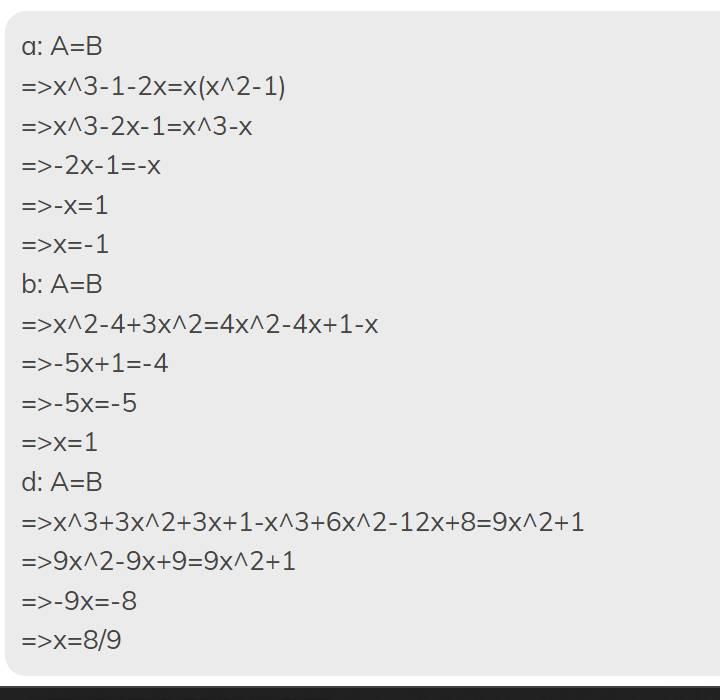
a) A= (x-3)(x+4)-2(3x-2) và B= (x-4)²
ta có:
(x−3)(x+4)−2(3x−2)= (x-4)²
=> \(x^2-5x-8=x^2-8x+16\)
=>3x=24
=>x=8
b) A= (x+2)(x-2)+3x² và B= (2x+1)² +2x
Ta có:
\(\left(x+2\right)\left(x-2\right)+3x^2=\left(2x+1\right)^2+2x\)
=> \(4x^2-4=4x^2+6x+1\)
=>6x=−5
=>\(x=-\frac{5}{6}\)
c) A= (x-1)(x²+x+1)-2x và B= x(x-1)(x+1)
ta có:
\(\left(x-1\right)\left(x^2+x+1\right)-2x=x\left(x+1\right)\left(x+1\right)\)
=>\(x^3-1-2x=x\left(x^2-1\right)\)
=>\(x^3-1-2x=x^3-x\)
=>\(x=-1\)
d) A= (x+1)³ -(x-2)³ và B= (3x-1)(3x+1)
ta có:
\(\left(x+1\right)^3-\left(x-2\right)^3=\left(3x-1\right)\left(3x+1\right)\)
=>\(9x^2+9x+9=9x^2-1\)
=>\(9x=10\)
=>x=\(\frac{10}{9}\)
chúc bạn học tốt
#Nghi