
Hãy nhập câu hỏi của bạn vào đây, nếu là tài khoản VIP, bạn sẽ được ưu tiên trả lời.

1. Hoi An villages are well - known for their beautiful vegetable and herb gardens.
2. Tourists can spend the morning on a local farm
3. Tourists recommended to buy handmade products to help local businesses.
1. Read the text. Match the highlighted words with their meanings.
(Đọc văn bản. Nối các từ được làm nổi bật với nghĩa của chúng.)
The more people travel, the bigger impact they may have on the environment. How can we reduce it while travelling? Here are some advice.
Reduce your carbon footprint while travelling. Since flying produces more carbon footprint than any other means of transport, you should only fly when the trip is long. During the trip, you should walk, cycle or use public transport as much as you can. This not only helps to keep the environment clean, but also allows you to enjoy the beauty of nature and interact with local people.
Choose eco-friendly activities that benefit animals and the ecosystem. Avoid activities that allow you to touch or ride animals because they disturb their natural patterns and attract many people. Instead, visit wildlife parks or organic farms. These will help you understand and respect the nature more and stop doing things that harm the environment.
Answer:
1. interact ->b: to talk or do things with other people.
2. benefit ->a: to be good for someone or something.
3. disturb ->c: to interrupt what people are doing and make them angry.

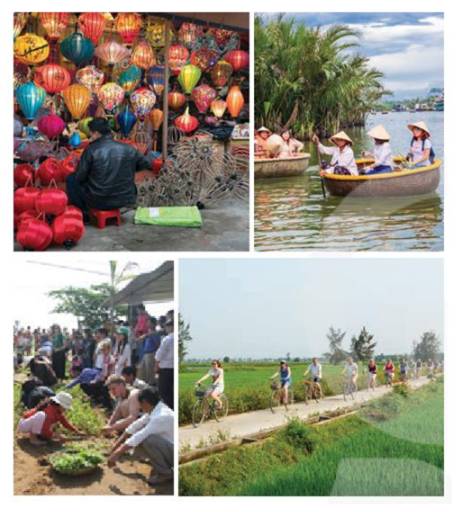

What do you think is special about Hoi An villages?
(Bạn thấy làng quê Hội An có gì đặc biệt?)
• beautiful vegetable and herb gardens
(vườn rau và thảo mộc xinh đẹp)
• coconut palms near the Thu Bon River
(rặng dừa gần sông Thu Bồn)
• traditional crafts such as colourful paper lanterns
(hàng thủ công truyền thống như đèn lồng giấy đầy màu sắc
What do you think tourists can do there?
(Bạn nghĩ khách du lịch có thể làm gì ở đó?)
• work on a local farm
(làm việc tại một trang trại địa phương)
• do the gardening at a local farm
(làm vườn tại một trang trại địa phương)
• ride bicycles through the villages travel on basket boats
(đi xe đạp qua các làng, du ngoạn trên thuyền thúng)
• visit craft villages
(tham quan làng nghề thủ công)
1. a | 2. b | 3. a | 4. c |
1. create (v): tạo ra
a. make something happen
(làm cho một cái gì đó xảy ra)
b. increase something
(tăng cái gì đó)
c. refuse something
(từ chối điều gì đó)
2. essential (adj): cần thiết
a. usual
(thường)
b. necessary
(cần thiết)
c. successful
(thành công)
3. respect (v): tôn trọng
a. have a good opinion of somebody
(có quan điểm tốt về ai đó)
b. look down on somebody
(khinh thường ai đó)
c. get on well with somebody
(có mối quan hệ tốt với người nào đó)
4. practical (adj): thực tiễn
a. connected with organisations
(kết nối với các tổ chức)
b. connected with ideas
(kết nối với các ý tưởng)
c. connected with real situations
(kết nối với các tình huống thực tế)
1. What was the mother doing? - She was sitting on a bench and talking to the boy.
(Người mẹ đang làm gì? – Cô ấy đang ngồi trên băng ghế và nói chuyện với cậu bé.)
2. What was the boy doing? - He was sitting on a bench and was not looking at his mother.
(Cậu bé đang làm gì? – Cậu bé đang ngồi trên băng ghế và không nhìn vào mẹ cậu ấy.)
3. What was the girl doing? - She was singing quietly and playing with a toy.
(Cô bé đang làm gì? – Cô bé đang hát thầm và chơi đồ chơi.)
4. What were the other travellers doing? - They were shouting greetings, waving goodbye, carrying heavy bags or running to catch trains.
(Những du khách khác đang làm gì? - (Họ đang chào nhau, vẫy tay tạm biết, mang những túi nặng hoặc chạy để bắt kịp tàu.)
5. What was the tall man doing? - He was standing near the exit and looking straight at the narrator.
(Người đàn ông cao lớn đang làm gì? – Anh ta đang đứng gần lối thoát hiểm và nhìn thẳng vào )
6. What were the cafe owners doing? - They were carrying tables outside.
(Các chủ quán ăn đang làm gì – Họ đang mang bàn ra ngoài.)
7. What was the dog doing? - He was lying on the pavement nearby.
(Con chó đang làm gì? – Nó đang nằm trên vỉa hè gần đó.)
8. What were teenage girls doing? - They were sitting on a bench and sharing headphones.
(Các cô gái teen đang làm gì? – Họ đang ngồi trên một băng ghế và chia sẻ tai nghe.)