

K
Khách
Hãy nhập câu hỏi của bạn vào đây, nếu là tài khoản VIP, bạn sẽ được ưu tiên trả lời.
Các câu hỏi dưới đây có thể giống với câu hỏi trên
27 tháng 7 2021
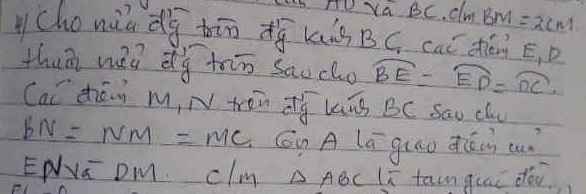
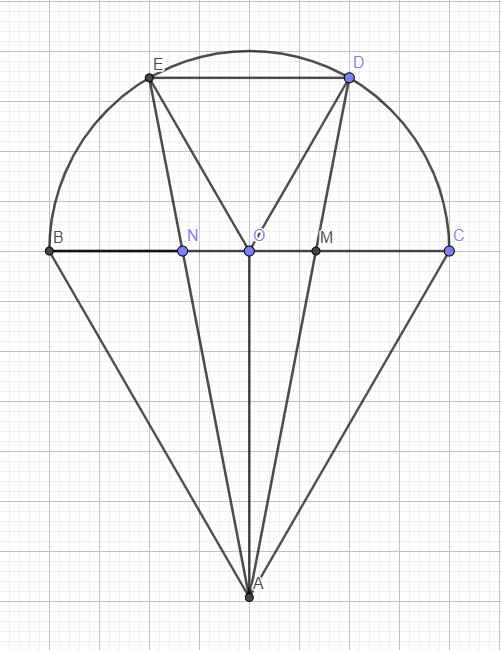
Gọi O là tâm đường tròn \(\Rightarrow\) O là trung điểm BC
\(\stackrel\frown{BE}=\stackrel\frown{ED}=\stackrel\frown{DC}\Rightarrow\widehat{BOE}=\widehat{EOD}=\widehat{DOC}=\dfrac{180^0}{3}=60^0\)
Mà \(OD=OE=R\Rightarrow\Delta ODE\) đều
\(\Rightarrow ED=R\)
\(BN=NM=MC=\dfrac{2R}{3}\Rightarrow\dfrac{NM}{ED}=\dfrac{2}{3}\)
\(\stackrel\frown{BE}=\stackrel\frown{DC}\Rightarrow ED||BC\)
Áp dụng định lý talet:
\(\dfrac{AN}{AE}=\dfrac{MN}{ED}=\dfrac{2}{3}\Rightarrow\dfrac{EN}{AN}=\dfrac{1}{2}\)
\(\dfrac{ON}{BN}=\dfrac{OB-BN}{BN}=\dfrac{R-\dfrac{2R}{3}}{\dfrac{2R}{3}}=\dfrac{1}{2}\)
\(\Rightarrow\dfrac{EN}{AN}=\dfrac{ON}{BN}=\dfrac{1}{2}\) và \(\widehat{ENO}=\widehat{ANB}\) (đối đỉnh)
\(\Rightarrow\Delta ENO\sim ANB\left(c.g.c\right)\)
\(\Rightarrow\widehat{NBA}=\widehat{NOE}=60^0\)
Hoàn toàn tương tự, ta có \(\Delta MDO\sim\Delta MAC\Rightarrow\widehat{MCA}=\widehat{MOD}=60^0\)
\(\Rightarrow\Delta ABC\) đều
KS


0


BN
12 tháng 8 2017
1. a) Ta có :A=99...9000...0+25(n chữ số 9,n +2 chữ số 0)
Đặt a=11...1(n chữ số 1 ) suy ra : 10n=9a+1.Khi đó :
A=9a.(9a+1).100+25=8100a2+900a+25=(90a+5)2=99...952
BN
13 tháng 8 2017
2.a)
Ta có :A=11...1\(\times\)10n+11...1-22...2(n chữ số 1 ,n chữ số 2)
Đặt a=11...1 (n chữ số 1) suy ra 10n=9a+1,22...2=2a.Khi đó :
A=(a(9a+1)+a)-2a=9a2=(3a)2=33...32(n chữ số 3)
b)Tương tự :B=a(9a+1)+a+4a+1=9a2+6a+1=(3a+1)2=33..342(n -1 chữ số 3)


13 tháng 7 2017
c)\(\sqrt{4-\sqrt{7}}-\sqrt{4+\sqrt{7}}\)
=\(\dfrac{\sqrt{8-2\sqrt{7}}}{\sqrt{2}}-\dfrac{\sqrt{8+2\sqrt{7}}}{\sqrt{2}}\)
=\(\dfrac{\sqrt{\left(\sqrt{7}-1\right)^2}}{\sqrt{2}}-\dfrac{\sqrt{\left(\sqrt{7}+1\right)^2}}{\sqrt{2}}\)
=\(\dfrac{\left|\sqrt{7}-1\right|-\left|\sqrt{7}+1\right|}{\sqrt{2}}\)
=\(\dfrac{\sqrt{7}-1-\sqrt{7}-1}{\sqrt{2}}\)
=\(\dfrac{-2}{\sqrt{2}}\)
=\(-\sqrt{2}\)


PA
22 tháng 10 2017
Bài 4:
a)
\(M=x+\sqrt{2-x}=-\left(2-x\right)+\sqrt{2-x}+2\)
Đặt \(\sqrt{2-x}=m\left(m\ge0\right)\)
\(\Rightarrow M=-m^2+m+2\)
\(=-\left(m^2-m+\dfrac{1}{4}\right)+\dfrac{1}{4}+2\)
\(=\dfrac{9}{4}-\left(m-\dfrac{1}{2}\right)^2\le\dfrac{9}{4}\)
Dấu "=" xảy ra khi \(m=\dfrac{1}{2}\Leftrightarrow\sqrt{2-x}=\dfrac{1}{2}\Leftrightarrow x=\dfrac{7}{4}\)
b)
\(5x^2+9y^2-12xy+8=24\left(2y-x-3\right)\)
\(\Leftrightarrow5x^2+24x+9y^2-48y-12xy+80=0\)
\(\Leftrightarrow\left(4x^2+9y^2+64-12xy-48y+32x\right)+\left(x^2-8x+16\right)=0\)
\(\Leftrightarrow\left(2x-3y+8\right)^2+\left(x-4\right)^2=0\)
\(\Leftrightarrow\left\{{}\begin{matrix}x=4\\y=\dfrac{16}{3}\end{matrix}\right.\) (loại)
Vậy . . .
PA
22 tháng 10 2017
Bài 2:
a)
\(M=\dfrac{x^5}{30}-\dfrac{x^3}{6}+\dfrac{2x}{15}\)
\(=\dfrac{x^5-5x^3+4x}{30}\)
\(=\dfrac{x\left(x^4-5x^2+4\right)}{30}\)
\(=\dfrac{x\left(x^2-4\right)\left(x^2-1\right)}{30}\)
\(=\dfrac{x\left(x-2\right)\left(x-1\right)\left(x+1\right)\left(x+2\right)}{30}\)
Suy ra nếu x nguyên thì M cũng nguyên ^.^
Bài 3:
a) Chứng minh \(VP\ge VT\) dùng Cauchy Shwarz dạng Engel.
b) Xét \(M=2a^2+2b^2+2\)
\(=\left(a^2+1\right)+\left(b^2+1\right)+\left(a^2+b^2\right)\)
\(\ge2a+2b+2ab\) (áp dụng bđt AM - GM)
\(\Rightarrow a^2+b^2+1\ge a+b+ab\left(\text{đ}pcm\right)\)
Bài 2:
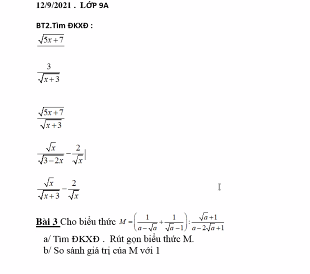
a: ĐKXĐ: 5x+7>=0
=>5x>=-7
=>x>=-7/5
b: ĐKXĐ: x+3>0
=>x>-3
c: ĐKXĐ: \(\begin{cases}5x+7>=0\\ x+3>0\end{cases}\)
=>\(\begin{cases}5x\ge-7\\ x>-3\end{cases}\Rightarrow\begin{cases}x\ge-\frac75\\ x>-3\end{cases}\)
=>\(x\ge-\frac75\)
d: ĐKXĐ: x>0 và 3-2x>0
=>x>0 và 2x<3
=>0<x<3/2
e: ĐKXĐ: x>0 và x+3>0
=>x>0 và x>-3
=>x>0
Bài 3:
a: ĐKXĐ: a>0; a<>1
\(M=\left(\frac{1}{a-\sqrt{a}}+\frac{1}{\sqrt{a}-1}\right):\frac{\sqrt{a}+1}{a-2\sqrt{a}+1}\)
\(=\left(\frac{1}{\sqrt{a}\left(\sqrt{a}-1\right)}+\frac{1}{\sqrt{a}-1}\right)\cdot\frac{\left(\sqrt{a}-1\right)^2}{\sqrt{a}+1}\)
\(=\frac{1+\sqrt{a}}{\sqrt{a}\left(\sqrt{a}-1\right)}\cdot\frac{\left(\sqrt{a}-1\right)^2}{\sqrt{a}+1}=\frac{\sqrt{a}-1}{\sqrt{a}}\)
b: \(M-1=\frac{\sqrt{a}-1}{\sqrt{a}}-1=\frac{-1}{\sqrt{a}}<0\)
=>M<1 với mọi x thỏa mãn ĐKXĐ
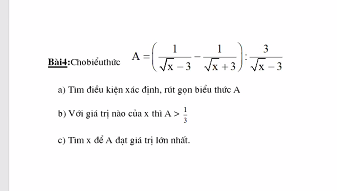
bài 4:
a: ĐKXĐ: x>=0 và x<>9
\(A=\left(\frac{1}{\sqrt{x}-3}-\frac{1}{\sqrt{x}+3}\right):\frac{3}{\sqrt{x}-3}\)
\(=\frac{\sqrt{x}+3-\left(\sqrt{x}-3\right)}{\left(\sqrt{x}-3\right)\left(\sqrt{x}+3\right)}\cdot\frac{\sqrt{x}-3}{3}=\frac{6}{3\left(\sqrt{x}+3\right)}=\frac{2}{\sqrt{x}+3}\)
b: \(A>\frac13\)
=>\(A-\frac13>0\)
=>\(\frac{2}{\sqrt{x}+3}-\frac13>0\)
=>\(\frac{6-\sqrt{x}-3}{3\left(\sqrt{x}+3\right)}>0\)
=>\(3-\sqrt{x}>0\)
=>\(\sqrt{x}<3\)
=>x<9
=>0<=x<9