LT
0

Hãy nhập câu hỏi của bạn vào đây, nếu là tài khoản VIP, bạn sẽ được ưu tiên trả lời.
3: \(\left|\frac{x^2-4x}{x^2+x+2}\right|\le2\)
=>\(-2\le\frac{x^2-4x}{x^2+x+2}\le2\)
\(\frac{x^2-4}{x^2+x+2}\ge-2\)
=>\(x^2-4\ge-2\left(x^2+x+2\right)\)
=>\(x^2-4+2x^2+2x+4\ge0\)
=>\(3x^2+2x\ge0\)
=>x(3x+2)>=0
=>x>=0 hoặc x<=-2/3(1)
\(\frac{x^2-4x}{x^2+x+2}\le2\)
=>\(x^2-4x\le2\left(x^2+x+2\right)\)
=>\(x^2-4x\le2x^2+2x+4\)
=>\(-x^2-6x-4\le0\)
=>\(x^2+6x+4\ge0\)
=>\(x^2+6x+9\ge5\)
=>\(\left(x+3\right)^2\ge5\)
=>\(\left[\begin{array}{l}x+3\ge\sqrt5\\ x+3\le-\sqrt5\end{array}\right.\Rightarrow\left[\begin{array}{l}x\ge\sqrt5-3\\ x\le-\sqrt5-3\end{array}\right.\) (2)
Từ (1),(2) suy ra x>=0 hoặc \(x\le-\sqrt5-3\)
Vì \(90^o< x< 180^o\Rightarrow\cos x< 0\)
Có: \(\sin^2x+\cos^2x=1\Leftrightarrow\left(\dfrac{2}{5}\right)^2+\cos^2x=1\Leftrightarrow\cos^2x=\dfrac{21}{25}\Leftrightarrow\cos x=-\dfrac{\sqrt{21}}{5}\left(vì\cos x< 0\right)\)
1:
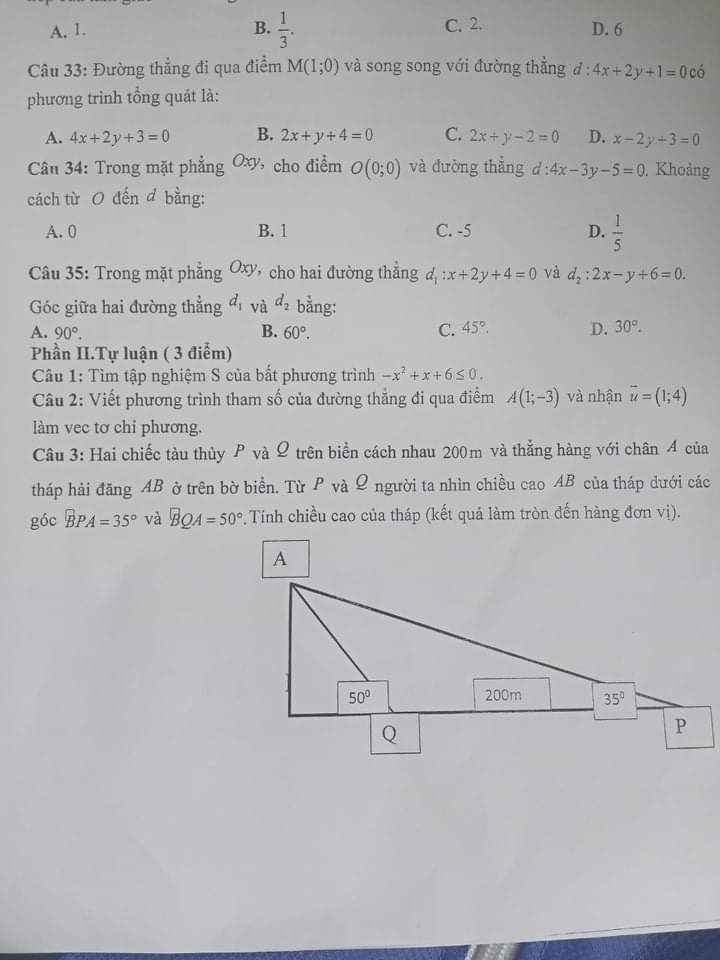
-x^2+x+6<=0
=>x^2-x-6>=0
=>(x-3)(x+2)>=0
=>x>=3 hoặc x<=-2
2:
Phương trình tổng quát của (d) là:
x=1+t và y=-3+4t
Gọi x(m) là chiều cao của điểm gãy so với gốc
(ĐIều kiện: x>0;x<9)
Chiều dài của phần cột bị gãy là 9-x(m)
Ta có hình vẽ sau:
Theo hình vẽ, ta có: \(x^2+3^2=\left(9-x\right)^2\)
=>\(x^2+9=x^2-18x+81\)
=>-18x+81=9
=>-18x=-72
=>x=4(nhận)
=>Chọn A
cosx(1 + 1/cosx + tanx)(1 - 1/cosx + tanx)
= cosx[(1 + tanx)² - 1/cos²x]
= cosx(1 + tan²x + 2tanx - 1 - tan²x)
= 2tanxcosx
= 2sinxcosx/cosx
= 2sinx
Chọn D
\(=cosx\left(1+\dfrac{1}{cosx}+\dfrac{sinx}{cosx}\right)\left(1-\dfrac{1}{cosx}+\dfrac{sinx}{cosx}\right)\)
\(=cosx\left(\dfrac{sinx+1+cosx}{cosx}\right)\left(\dfrac{cosx+sinx-1}{cosx}\right)\)
\(=\left(cosx+sinx\right)^2\)\(-1\)
\(=cos^2x+2cosxsinx+sin^2x-1\)
\(=cos^2x+sin^2x+2cosxsinx-1\)
\(=1+2cosxsinx-1\)
\(=2cosxsinx\)
Áp dụng đẳng thức góc nhân đôi cho sin
\(=2sinx\)
Hiểu như này:
\(\dfrac{a}{1+a}+\dfrac{b}{1+b}+\dfrac{b}{1+b}=3-\left(\dfrac{1}{1+a}+\dfrac{1}{1+b}+\dfrac{1}{1+b}\right)\le3-\dfrac{9}{1+a+1+b+1+b}=\dfrac{3\left(a+2b\right)}{3+a+2b}\)