
Hãy nhập câu hỏi của bạn vào đây, nếu là tài khoản VIP, bạn sẽ được ưu tiên trả lời.
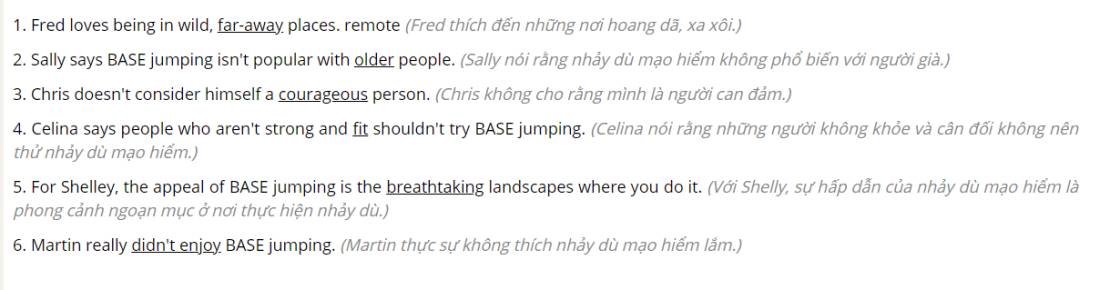

1. like: love, (be) keen on, enjoy, ...
dangerous: risky, serious, threatening, ...
2. told (tell): say, speak, ...
3. didn't enjoy: hate, dislike, ...
4. venue: place, location, site, ...
5. danger: risk, threat, insecurity, ...
6. great: good, wonderful, awesome, ...
sportswoman: athlete, ...
1. Read the text. Match the highlighted words with their meanings.
(Đọc văn bản. Nối các từ được làm nổi bật với nghĩa của chúng.)
The more people travel, the bigger impact they may have on the environment. How can we reduce it while travelling? Here are some advice.
Reduce your carbon footprint while travelling. Since flying produces more carbon footprint than any other means of transport, you should only fly when the trip is long. During the trip, you should walk, cycle or use public transport as much as you can. This not only helps to keep the environment clean, but also allows you to enjoy the beauty of nature and interact with local people.
Choose eco-friendly activities that benefit animals and the ecosystem. Avoid activities that allow you to touch or ride animals because they disturb their natural patterns and attract many people. Instead, visit wildlife parks or organic farms. These will help you understand and respect the nature more and stop doing things that harm the environment.
Answer:
1. interact ->b: to talk or do things with other people.
2. benefit ->a: to be good for someone or something.
3. disturb ->c: to interrupt what people are doing and make them angry.
Refer
There are several things that we should do to reduce the negative impact of travelling on the environment. First of all, we should reduce our carbon footprint during the trip. We should only fly when the trip is long and choose environmentally-friendly means of transport such as cycling or public transport. The next thing is that wherever we go, we should always protect our environment. By keeping it clean and safe, we can reduce the negative impact of travelling on the environment. In addition, we had better choose activities that are good for local people and the environment. These will not only help us understand but also respect the nature more and stop doing things that harm the environment and local area as well
Viet Nam has gained three main benefits since it joined different international organisations. First, promoting its culture and get to know other cultures. Various cultural exchanges help visitors know more about our country. Besides, Vietnamese people have a better chance of experiencing different cultures. Second, creating more educational opportunities for both Vietnamese and foreign students. Greater educational opportunities abroad are now open to Vietnamese students. Viet Nam’s colleges and universities can also accept international students. Finally, increasing both local and international tours. Our country has become one of the most popular destinations for foreign tourists in the region. It is also easier for Vietnamese people to travel abroad.
Tạm dịch:
Việt Nam đã đạt được ba lợi ích chính kể từ khi gia nhập các tổ chức quốc tế khác nhau. Đầu tiên, quảng bá văn hóa của mình và làm quen với các nền văn hóa khác. Các hoạt động giao lưu văn hóa đa dạng giúp du khách biết thêm về đất nước chúng ta. Bên cạnh đó, người Việt Nam có cơ hội trải nghiệm nhiều hơn các nền văn hóa khác nhau. Thứ hai, tạo ra nhiều cơ hội giáo dục hơn cho cả sinh viên Việt Nam và sinh viên nước ngoài. Các cơ hội giáo dục lớn hơn ở nước ngoài đang mở ra cho sinh viên Việt Nam. Các trường cao đẳng và đại học của Việt Nam cũng có thể tiếp nhận sinh viên quốc tế. Cuối cùng là tăng cả các tour du lịch trong nước và quốc tế. Đất nước chúng ta đã trở thành một trong những điểm đến được ưa chuộng nhất của du khách nước ngoài trong khu vực. Người Việt Nam đi du lịch nước ngoài cũng dễ dàng hơn.
A. Dave felts amused when he played prank on his sister and felt guilty after seeing his sister get over from it. (Dave cảm thấy thích thú khi chơi khăm chị của cậu ấy và hối hận sau khi thấy chị ấy khó khăn vượt qua nó.)
B. Dave’s big sister felt angry when she knew his prank and frightened when she saw the fake spider.
(Chị cả của Dave cảm thấy tức giận khi biết trò khăm của cậu ta và thấy kinh hãi khi thấy con nhện giả.)
C. Kate felt anxious when she gave his brother the card and felt pleased when his brother’s crush agreed to go out with him.
(Kate cảm thấy lo lắng khi cô ấy đưa anh trai tấm thiệp và cảm thấy vui mừng khi người anh trai thích đồng ý đi chơi với cậu ấy.)
D. Kate's brother felt angry when he found out the girl didn’t send him the card and felt pleased when she agreed to go out with him.
(Anh trai của Kate đã tức giận khi tìm ra cô gái đó không gửi anh tấm thiếp và cảm thấy vui mừng khi cô ấy đồng ý đi chơi với anh.)
1. a | 2. b | 3. a | 4. c |
1. create (v): tạo ra
a. make something happen
(làm cho một cái gì đó xảy ra)
b. increase something
(tăng cái gì đó)
c. refuse something
(từ chối điều gì đó)
2. essential (adj): cần thiết
a. usual
(thường)
b. necessary
(cần thiết)
c. successful
(thành công)
3. respect (v): tôn trọng
a. have a good opinion of somebody
(có quan điểm tốt về ai đó)
b. look down on somebody
(khinh thường ai đó)
c. get on well with somebody
(có mối quan hệ tốt với người nào đó)
4. practical (adj): thực tiễn
a. connected with organisations
(kết nối với các tổ chức)
b. connected with ideas
(kết nối với các ý tưởng)
c. connected with real situations
(kết nối với các tình huống thực tế)